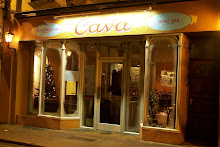
About Cava

My photo
Galway, Ireland
Cava opened in May 2008. It is the only Spanish Restaurant in Galway. It serves Tapas,á la carte, Lunch and brunch and is opened 7 days a week. It is said to have the best Tapas in Ireland and its all Spanish Wine and beer menu is the largest in Ireland.

Sunday, October 17, 2010

C is for Chorizo

Spanish chorizo is made from coarsely chopped pork and pork fat, seasoned with smoked pimentón (paprika) and salt. It is generally classed as either picante (spicy) or dulce (sweet), depending upon the type of smoked paprika used.

There are hundreds of regional varieties of Spanish chorizo, both smoked and unsmoked, which may contain garlic, herbs and other ingredients. Chorizo comes in short, long, hard and soft varieties, some of which are suited to being eaten as an appetizer or tapas, whereas others are better suited to cooking.


Leaner varieties are typically better suited to tapas, eaten at room temperature, whereas fattier versions are generally used for cooking. A general rule of thumb is that long, thin chorizos are sweeter and short chorizos are spicy, although this is not always the case.

As well as chorizo, Spain also produces lomo and salchichón, cured and air dried in a similar way. Lomo is a lean cured meat to slice, made from the loin of the pig, which is marinated and then air-dried. Salchichón is another cured sausage without the pimentón seasoning of chorizo, but flavoured with black peppercorns instead.

In Cava, we have two varieties of Chorizo, cured and raw, and a Salchichón and Lomo.

If you order our cheese and meat platter you can try at least four different types of cured meat!

Tuesday, August 24, 2010

B is for Bacalao

Salting cod in the 19th century
Salted cod for sale
Bacalao is fresh cod loin which has been salted in order that it be preserved. The tradition of making bacalao dates back many centuries and is in no way particular to the Spanish, though it is an essential ingredient for Basque cuisine.
 
Salt cod is also produced in Canada, Iceland, and Norway, and has been for over 500 years. It forms a traditional ingredient of the cuisine of many countries around the Atlantic. Traditionally, salt cod was dried only by the wind and the sun, hanging on wooden scaffolding or lying on clean cliffs or rocks near the seaside.
The drying of food is the world's oldest known preservation method, and dried fish has a storage life of several years.  The method was cheap, the work could be done by the fisherman or his family, and the resulting product was easily transported to market. Salting became economically feasible during the 17th century, when cheap salt from southern Europe became available to the maritime nations of northern Europe.
 
Nowadays, in Spain, you can buy bacalao in the supermarket. In order to use it, you must soak it in water for at least 24 hours, changing the water periodically.
 
Salted cod goes really well with roast tomatoes, chickpeas, and many leaves, including rocket.

The best way to cook it ti to place it in cold water and bring it to the boil. Once the fish is entirely opaque it is ready. This does not take long. 

In Andalusia, there is a wonderful salad of salted cod, oranges, and walnut. We serve this in Cava at the moment.

Perhaps most famously, Bacalao is used to made salted cod cakes, called Buñuelos de bacalao in Spanish These have been on the menu in Cava since we opened and will presumably be there for a long time to come.
 
Buñuelos de bacalao


Friday, August 20, 2010

A is for Albariño

Albariño is a variety of white wine grape grown in Galicia (northwest Spain) where it is used to make varietal and blended white wines.

It was presumably brought to Iberia by Cluny monks in the twelfth century. Its name "Alba-Riño" means "the white [wine] from the Rhine" and it has locally been thought to be a Riesling clone originating from the Alsace region of France, although earliest known records of Riesling as a grape variety date from the 15th, rather than the 12th, century. It is also theorized that the grape is a close relative of the French grape Petit Manseng.


Spain produces Albariño to a significant degree in the Rías Baixas DO, especially in the town of Cambados.  In other locations such as Ribeiro, Lima, Braga or Valdeorras it is often mixed with other grapes such as Godello, to produce blended wines. Such blends were common throughout Galicia too until about 1985; when the Rías Baixas DO was established on an experimental basis in 1986, Albariño began to emerge as a varietal, both locally and international. Its recent emergence as a varietal led the wines to be for wine drinkers who wanted clean flavors and rich, ripe fruit". This has led to wines completely different from those produced across the river in Portugal.

The grape is noted for its distinctive aroma, very similar to that of Viognier and Gewurztraminer, suggesting apricot and peach. The wine produced is unusually light, and generally high in acidity with alcohol levels of 11.5–12.5%. Its thick skins and large number of pips can cause residual bitterness.

At Cava, we have a number of Albariño's, the most famous of which is the Albariño Castro Martin. It will sent you back about €40. Because of its more complex character, Albariño goes well with food, especially fish and chicken and pork. Why not try with our free range pork next time you're in.

Jp


Saturday, July 24, 2010

On Sherry

Sherry is a fortified wine made from white grapes that are grown near the town of Jerez, Spain. The word "sherry" is an anglicization of Jerez. In earlier times, sherry was known as sack (from the Spanish saca, meaning "a removal from the solera"). In the European Union "sherry" is a protected designation of origin; therefore, all wine labeled as "sherry" must legally come from the Sherry Triangle, which is an area in the province of Cádiz between Jerez de la Frontera, Sanlúcar de Barrameda, and El Puerto de Santa María.

After fermentation is complete, sherry is fortified with brandy. Because the fortification takes place after fermentation, most sherries are initially dry, with any sweetness being added later. In contrast, port wine (for example) is fortified halfway through its fermentation, which stops the process so that not all of the sugar is turned into alcohol.

Sherry is produced in a variety of styles, ranging from dry, light versions such as finos to much darker and sometimes sweeter versions known as olorosos.

Tuesday, June 15, 2010

On Chorizo

Spanish chorizo is made from coarsely chopped pork and pork fat, seasoned with smoked pimentón (paprika) and salt. It is generally classed as either picante (spicy) or dulce (sweet), depending upon the type of smoked paprika used.

There are hundreds of regional varieties of Spanish chorizo, both smoked and unsmoked, which may contain garlic, herbs and other ingredients. Chorizo comes in short, long, hard and soft varieties, some of which are suited to being eaten as an appetizer or tapas, whereas others are better suited to cooking.

Leaner varieties are typically better suited to tapas, eaten at room temperature, whereas fattier versions are generally used for cooking. A general rule of thumb is that long, thin chorizos are sweeter and short chorizos are spicy, although this is not always the case.

As well as chorizo, Spain also produces lomo and salchichón, cured and air dried in a similar way. Lomo is a lean cured meat to slice, made from the loin of the pig, which is marinated and then air-dried. Salchichón is another cured sausage without the pimentón seasoning of chorizo, but flavoured with black peppercorns instead.

Friday, June 4, 2010

New Menu Lauched

We launched our new menu on Wednesday and it seems to be well received. Although we were short a few items we went ahead with it anyway. The soft launch proved the better one, as by Thursday all was going smoothly with the new Tapas. The Basque style Monkfish, Rack of Pork with Sherry marmalade, and the Spring Lamb Shoulder with honey aoili are all selling well. All of these Tapas are slightly larger than most and would probably feed two if required.

Full house tonight, so better go!

Jp

Friday, May 28, 2010

Nearly June

Just a few short words before May ends and June begins. The restaurant is heating up with a bigger influx of diners so I hope this continues. Spring Lamb is all about and ours is coming from both Collerans Butchers in Galway and Castlemine Free range farm in Roscommon. Both are very good butchers and supply stuff to both Sheridans on the docks and Bar 8 (two other fine establishments in my eyes).

While asparagus is heading out of season, beetroot is coming in so expect a nice lamb and beetrot recipe is the coming days on the website.

Also, with Ireland not in the World Cup, Cava will be behind Spain all the way: so bring on the 16th when Spain open to Honduras. Hopefully its an excellent and colourful World Cup.

Finally: the Cooking classes are going strong and with our first publication (a little cookbook) included in the class, they really are a fine way to learn about food, Spain, and the catering Industry.

Until next time,

Jp 

Friday, May 14, 2010

On May in the middle

Well May is in the middle of the month and the tapas are tipping away  tip tip and everyday you're up and down to the kitchen and you do the orders and you think about it all from the local to the organic to the carrots in the corner which come from Israel and you wonder why they're here and how they got here and you make a note to try and look out for the Irish things but we all have to keep the world going and then you have a look through your book and write a few specials and then that's your day the restaurant opens and the phone rings and then you cook and serve and make it all or all you can make and you continue through the day knowing how much you've left out because you always leave out so much o you know how much I've left out six seconds of the last few moments and the music play and you make a tapa or two and think of your child ah sure isn't she only great and the things that can go wrong might go wrong just keep cooking and answering those calls even if they're only advertising and they want your money but sure isn't it all about that always about that someone getting someones money and making a tapa or two a tapa or two and then we're gone again gone again and then back again in no time no time at all.

Wednesday, April 28, 2010

Cuirt comes to a close

Cuirt came to a close on Sunday and they all came in to Cava on Monday to end a great week of writing and literature. I'm glad, in spite of the ash, that there week went well. With two readings held in Cava, I'm happy we can be a part of the event.

That make Monday busy with two tables of 15 to be served, but all went well.

Tuesday started of well with a steady lunch and continued into night with Szymon and Sara cooking up a little storm.

We also had some catering for the Corrib Princess, which started this month.

All steam a head. 

Monday, April 26, 2010

On this day ....

On this day, the 26th of April in 1937 during the Spanish Civil War, the Bombing of Guernica took place. The Condor Legion of the German Luftwaffe carpet bombed and machined gunned the city resulting in a devastating firestorm that caused widespread destruction and civilian deaths in the Basque town. Pablo Picasso depicted the bombing of Guernica by German and Italian warplanes at the behest of the Spanish Republican government. They asked him to create a large mural for the Spanish display at the Exposition Internationale des Arts et Techniques dans la Vie Moderne (1937) Paris International Exposition in the 1937 World's Fair in Paris and following the bombing he decided to depict this event. On February 5, 2003, a large blue curtain was used to cover up a tapestry copy of Picasso's Guernica hanging at the entrance to the Security council room, so that it would not be visible in the background when Colin Powell and John Negroponte gave press conferences at the United Nations justifying why the United States of America must go to war with Iraq.

Just a little bit of history for you.

Tuesday, April 13, 2010

Over the Easter

Well last week was really something. Every night they came and every night they ate and drank their fill. This is the kind of thing that we (and Galway) really need. I don't know if it was the teachers meeting on in NUIG or whether it was just the Easter Holidays. We sold buckets loads of Duck and plum and Venison sausages, but we also sold plenty of the old favorites like Tortilla and Patatas Bravas.

I suppose this week will be a but quieter as the good weather seems to send them all out to Salthill. But we do get a few back in town around 8 for some Tapas and Wine.

Wine to Try: we have a new wine from Campo de Borja. I've attached some information below.

Campo de Borja is a Spanish Denominación de Origen (DO) for wines located in the northeast of the province of Zaragoza (Aragon, Spain). It is a transition zone between the plains of the River Ebro and the mountains of the Sistema Ibérico. The DO comprises 16 municipalities. The Moncayo mountain is the dominant feature of the DO and creates a microclimate which gives the wines a special character.

Authorized red grapes: Garnacha & Tempranillo (two typical Spanish grapes) Mazuela, Cabernet Sauvignon, Merlot, Syrah (used all around the world for red wine making)

Authorised white grapes: Macabeo & Moscatel (two grapes that are used for making cava and sherry)


That's all for now.

Jp

Monday, March 29, 2010

Very busy last night in the restaurant with a lot of Tapas coming out of the kitchen. Saturday was the same which is a good sign given the last two weekends were a bit quieter. The cooking classes are in full swing and I really things that people are enjoying them. I include a book here by Jose Andres one of my favorite Spanish chefs currently at large (that is the right word) in America. His type of cooking is inspired by El Bulli but he very much keeps to his own rustic inspired terrain.

Enjoy!

P.S. By the way, Cava are catering for Cúirt (Galway's best literature festival), who launched their program last week. Check it out. There lots to look at and listen to!

Friday, March 26, 2010

The end of the fair

Who would have thought that tasting food and wine would become a job! A taxing one at that. After the fair yesterday I was certainly under the influence but a good walk in the good city did me the world and we went tapas hoping from bar to bar. Ate in a nice restaurant in the upper part of the town - had a traditional dish of salted cod belly in a clam broth, nice but the desserts were great - crema catalana mousse with apple sorbet inside it! Well well.

Of to see a few more things today for Cava and get some fresh ideas regarding the restaurant and food. Lovely relaxing culture over here where one could drink little beers (no pints gentlemen) all day with the odd coffee thrown in for good measure.

What is the measure of our lives, as old Freud said?

On another note, we're about to leave the hotel and I just about to type something Drigin spoke and it all disappeared.

The weather outside is absolutely smashing and we're of for a walk and a spot of late breakfast. Again, a wonderful city to walk around and take it all in.

Jp

(the 21st century Flaneur)

Wednesday, March 24, 2010

In Spain

Hello from Spain and the biggest food and wine fair in Barcelona. We're looking for some Spanish Suppliers to help us up our game in Cava. Weather in not to great though: dull and overcast, but humid all the same. Hotel told us we were ten minutes walk from the site, but we really are ten minutes travel (5km). I don't know who can do 5km in 10 minutes, if you know anyone, please contact the hotel.

Matt is here as well and gone scouting ahead.

Hope to meat some really good cheese, meat, wine, and oil, suppliers as well as see some food presentations. They all go mental for the Nouveau Tapa here with their gas and air so we'll see what that brings.

Will keep you informed.

Sunday, March 14, 2010

Mother's Day

Today in Cava we're giving away a glass of Cava for every mother. So come on down. ID essential.

Wednesday, March 3, 2010

Reflections on March

Well it's march already and the pie and made and yes they do have more fish in them yes they do and the cooking classes are going well indeed they are indeed they are what more could you want maybe for the rent to come down or the banks not to be making so many mistakes but really are either of those things going to happen I doubt it I doubt it but all the same cava is going from strength to strength but you're really not suppose to say those things at this point in time at this point in the history of this lovely isle called Ireland and so what if you're chicken is not big enough or is french if it taste's good then why not I say then why bloody not and what all this I hear about cava and winning some award for best Spanish restaurant in Ireland and sure maybe so maybe so but when you're in there in the middle of it all you wonder how it all keeps going and it does but some times its hard and you're up to your neck in paella and all you can do is sing or have a sherry because that's what sorts it all out yes yes yes please give me another drink ...

Monday, February 8, 2010

Food suppliers and travels

Off at the moment looking for more free range food for cava, in terms of its chicken, lamb, pork and beef. Found a few outside Galway, such really nice farms. Important to try and drag it all in, from farm to fork.

Aside from that we were around Ireland, and ate in lovely really nice restaurants, in particular Patrick Guilbaud (Dublin); Campagne (Kilkenny) - a really fabulous place and certainly one of the best eatery's of its category in the country.

We also went to Ballymore Inn (Wicklow), and had a lovely lunch there - fine steak and pizza, a pity its so of the beaten track.

We could do with a few of these in Galway.

Back to work on Wednesday, making fish pies and chowder for Stefan.

In all, a nice weekend away.

Jp

Friday, January 29, 2010

Seville Tapas Fair

Cava is busy preparing for the Seville Tapas Fair, with a special Tapas menu for groups of 8 or more to share. The Festival which takes places in the streets and restaurants of Seville during the month of February, is both a national and international festival which brings many people to the south of Spain in search of good food and wine.

In conjunction with this event, Cava has designed a menu for people to share. The idea of sharing is essential to Tapas, and this way people get to experience a lot more of the Tapas thing that coming in on their own.

The menu runs for the duration of February and is an excellent way for friends to get together and have some fun.

Wine and dessert is also includes in the menu @ €25 per person

Booking is essential, so call Cava is you're interested @ 091 - 539884

Talk soon, Jp

Thursday, January 21, 2010

Come on down to Cava and taste a tipple of Spain

The fish is coming in from Stefan and we have 68 people booked in and its only Thursday. Where do they all come from? I don't know, but coming they are, and with Szymon and Louise busy preparing for tonight, I'm sure it will be gloves off and around 7, no doubt, a fair amount of bare knuckle boxing will take place.

The new menu is printed. So come on down to Cava and taste a tipple of Spain or just have a drink and get drunk and be merry and hug someones with a mouth full of meatballs!

Jp

Tuesday, January 19, 2010

Reflections on a Recession (January)

What can I say?
It has not been too bad in old Cava.
People are still coming in having food and drinking wine.
We will not say they are coming in their thousands.
But they are coming all the same.
We got a great write up in the Mail over the weekend!
So I'm sure this will help things.
The wine menu is finished and going to print tomorrow.
Over 80 Spanish wines - the biggest in the country!
Can't wait to try some of the expensive ones.
Shared the €105 Christopher Lopez with staff over xmas.
Literally (and figuratively) amazing.
Best wine I have had in years.
You may say, how can you spend that on a wine.
We got six glasses - about €17.50 a glass.
But you only live once.

At least the last time I checked.

So what have we learned:

1) That January is not as bad as I thought it would be.

2) Wine that cost over €100 a bottle in most likely good (this is not to say our €20 wine is bad - it is not, just that it's the different between Ryanair and a private jet).